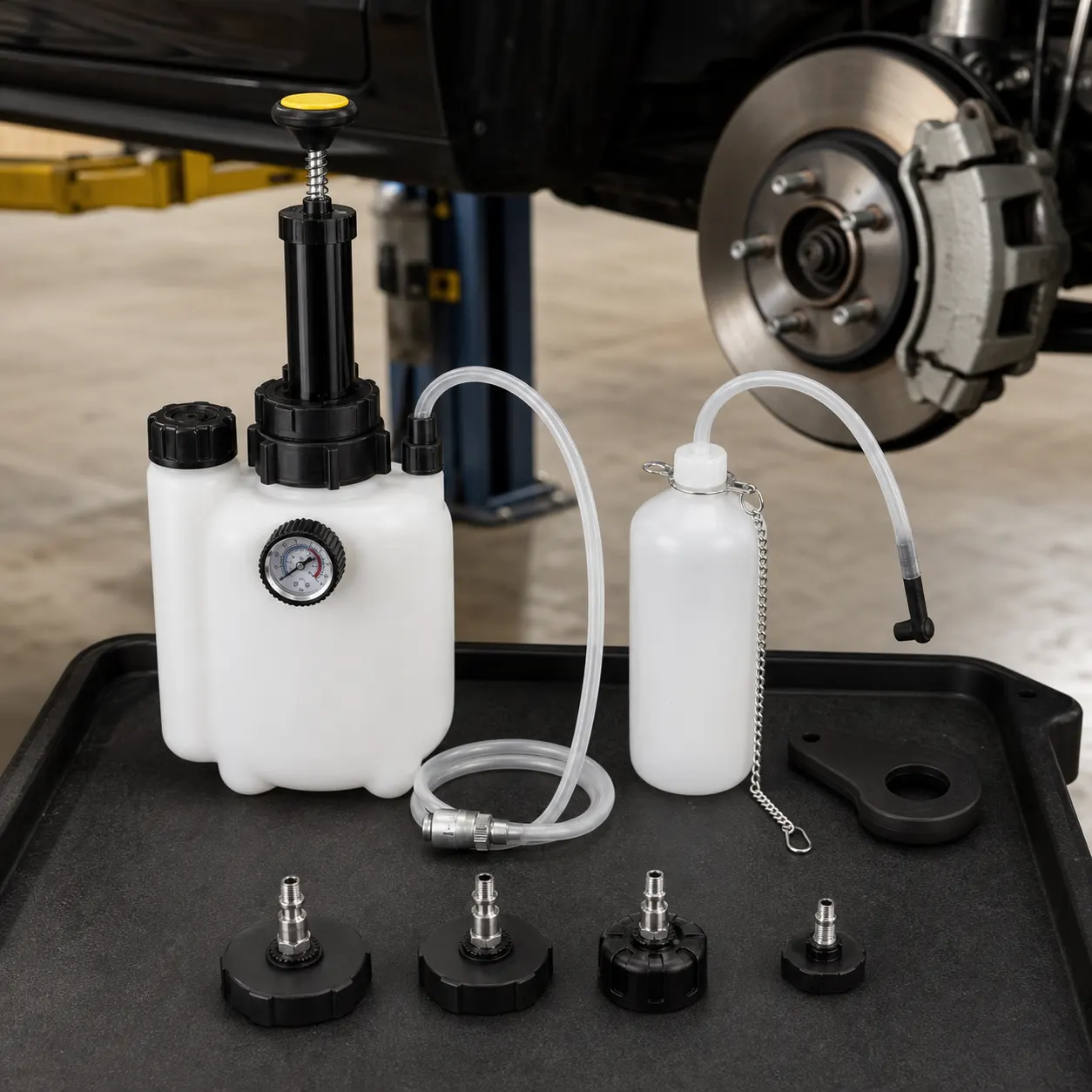
Short answer: A brake fluid refill bottle can support the reservoir side of a brake or clutch bleeding job, but it is not a complete bleeding system and does not make an unknown procedure safe. Carbleeder lists a 3L automotive fluid refill bottle with four adapters under SKU VKS6003-4. The manufacturer does not specify which vehicles or reservoir necks those adapters fit, which fluid grades are compatible, or any pressure capability. Before buying, match the exact vehicle procedure and fluid specification, assess spill and access risks, and use a competent repairer when the hydraulic work is outside your training.
Decide whether refill support is the missing tool
The product page places the bottle at the fresh-fluid side of automotive repair. Its stated role is refill use for brake fluid, clutch fluid and oil. That scope does not establish a method for moving fluid through a hydraulic circuit, collecting discharged fluid or diagnosing a soft pedal. Define the missing part of the job before treating the bottle as the answer.
If the requirement is simply to keep an appropriate reservoir supplied during an approved procedure, the product category may be relevant. If the requirement is pressure bleeding, vacuum bleeding, ABS actuation, fault diagnosis or waste-fluid collection, the manufacturer does not specify that this bottle provides those functions.
| Job requirement | What the listing supports | What remains separate |
|---|---|---|
| Fresh-fluid supply | 3L refill bottle with four adapters | Exact reservoir fit and fluid grade |
| Moving fluid through the circuit | Manufacturer does not specify | Vehicle-approved bleeding method and equipment |
| Collecting old fluid | Manufacturer does not specify | Suitable labelled waste collection |
| Diagnosing braking faults | Not a stated function | Competent inspection and repair |
Check the vehicle and fluid specification
Brake-fluid requirements differ by vehicle, so use the owner's or workshop information for the exact model rather than a generic DOT assumption. Tesla's official service guidance, for example, tells owners not to top up brake fluid themselves and specifies using the appropriate brake fluid where the documented service procedure is performed. That example shows why the bottle listing cannot determine the correct fluid or authorise the work.
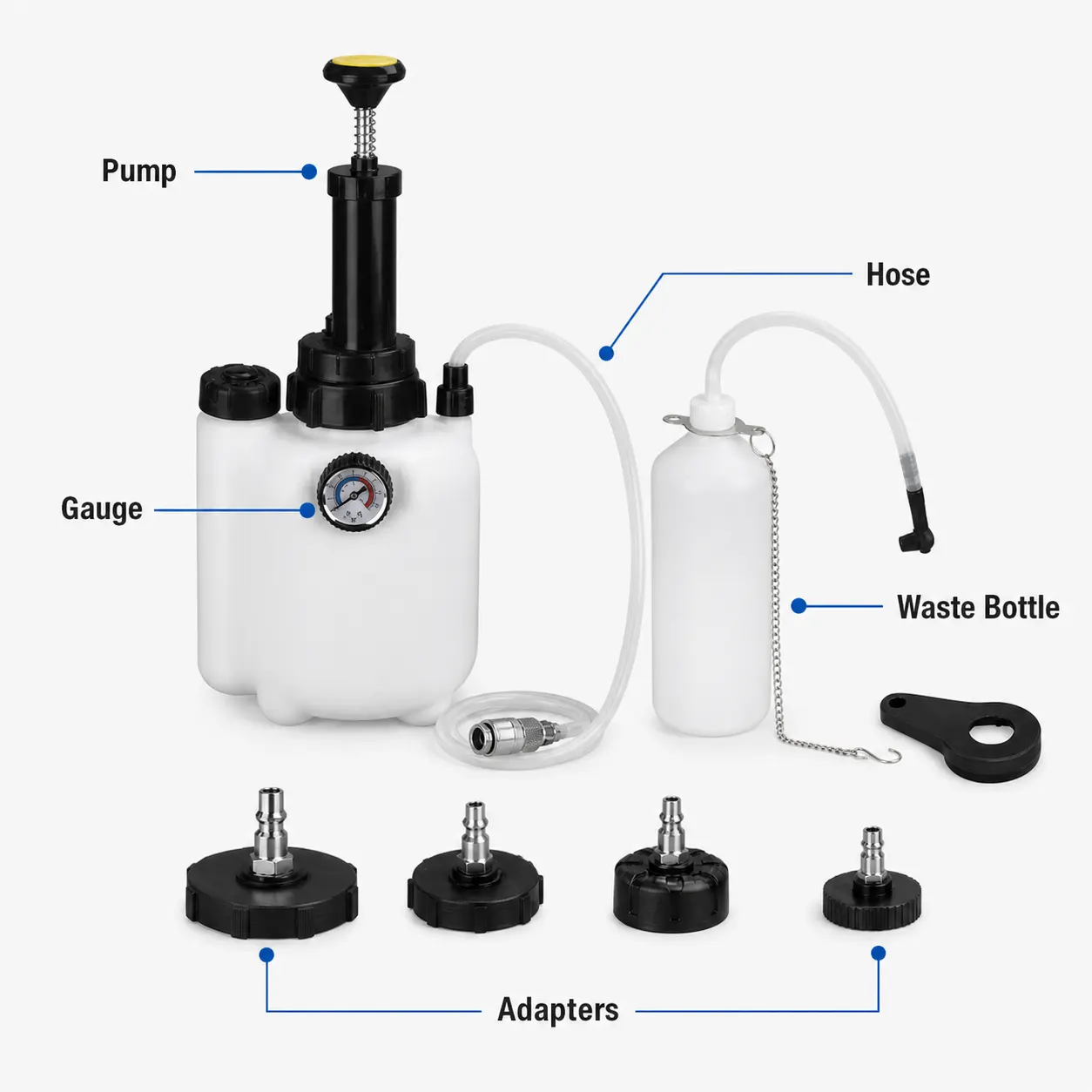
The same evidence rule applies to the adapters. Four are supplied, but the manufacturer does not specify their threads, dimensions, cap standards or compatible vehicles. Compare documented adapter information with the reservoir before adding fluid. Do not force a part that looks close or infer compatibility from a product photograph.
- Identify the exact vehicle, brake or clutch circuit and manufacturer procedure.
- Confirm the required fluid specification from authoritative vehicle information.
- Obtain documented adapter dimensions or fitment for the reservoir.
- Reject the setup if fit, stability or fluid compatibility remains uncertain.
Control brake-fluid and access risks
HSE lists brake fluids among substances hazardous to health in motor vehicle repair. Keep the fluid in its labelled container until needed, follow its safety data sheet and prevent contamination. Where the risk assessment identifies chemical splash, HSE says eye protection must be suitable for the task and fit the user; gloves and clothing must likewise be selected for the substance and exposure route.
A refill bottle does not make access beneath a vehicle safe. Where bleed points require raised-vehicle access, follow HSE guidance for work underneath vehicles and use properly rated support on suitable ground. Do not rely on a lifting jack alone. Stop if the vehicle, reservoir, nipple or hydraulic condition makes the work uncertain.
- Read the brake-fluid safety data sheet before handling or disposal.
- Use PPE selected for the actual splash and skin-contact risk.
- Protect the work area and keep fresh fluid separate from waste fluid.
- Use safe vehicle support and keep untrained people out of the work area.
Limits to resolve before ordering
The product page confirms the 3L capacity, four adapters, VKS6003-4 SKU and automotive refill category. The manufacturer does not specify universal fit, adapter sizes, pressure limits, fluid-grade compatibility, seals, cleaning instructions, certification, ABS support or a vehicle-specific bleeding sequence.
Those unknowns set a clear buying boundary. Order only when the refill role matches an established method and the adapter and fluid evidence match the vehicle. If the braking system has a leak, warning, abnormal pedal or unresolved fault, use an appropriately competent repairer rather than treating a refill accessory as a remedy.
Related guides and product details
Buy the Carbleeder bottle only as verified refill support for a known vehicle procedure. Confirm fluid and adapter fit first, then keep brake-fluid handling, safe access and final brake checks within competent workshop guidance. Read Brake Fluid Reservoir Bottle: Role, Fit and Safety for related guidance. Read One-Man Brake Bleeding Bottle: What to Check First for related guidance. Review the documented specification on the 3L Brake Fluid Refill Bottle with 4 Adapters product page before ordering.
Sources and safety context
- Supports the 3L bottle, four adapters, VKS6003-4 SKU and stated automotive refill scope. Current Carbleeder product page.
- Identifies brake fluids as hazardous substances encountered in motor vehicle repair. HSE: COSHH and motor vehicle repair.
- Supports selecting eye and body protection for chemical splash according to the task. HSE: Using the right type of PPE.
- Supports the raised-vehicle access boundary and proper vehicle support. HSE: Working safely under motor vehicles.
- Manufacturer example showing that vehicle-specific instructions control whether brake fluid is topped up and which appropriate fluid is used. Tesla: Checking Brake Fluid.